Plant Care Guide
String of Pearls Care: The Complete Guide
String of Pearls (Curio rowleyanus) is a trailing succulent native to the dry regions of southwest Africa, known for its hanging stems of spherical pea-shaped leaves, capacity to cascade well below the pot rim, and need for bright direct light and infrequent watering. Water deeply every 2–3 weeks in summer and every 4–6 weeks in winter, allowing the soil to dry fully between waterings.
Quick facts
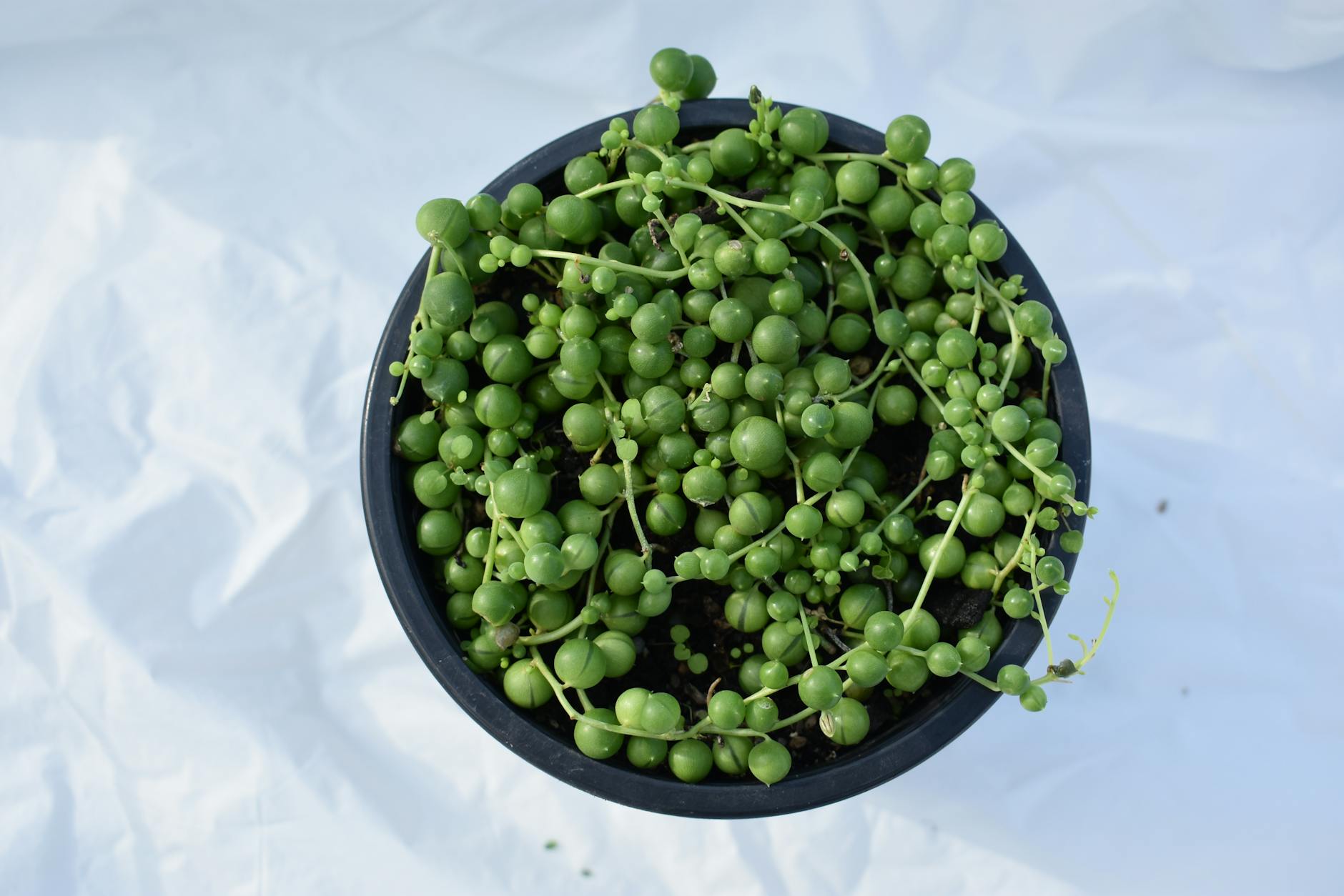
The String of Pearls looks like what it sounds like: a trailing string of small, round, green beads. Each bead is not a decoration — it is a modified leaf, a water storage organ that keeps the plant alive through weeks of drought. A tiny translucent window on one side of each pearl lets light through to the photosynthesising tissue inside, while the spherical shape minimises surface area and reduces water loss. The whole plant is an engineering solution to surviving a dry climate. Understanding that explains everything about how to care for it.
At a glance: String of Pearls care
- Light: Bright, with some direct morning or afternoon sun tolerated.
- Water: When the top 2-3cm of soil is dry. Less forgiving of overwatering than most succulents.
- Humidity: Low. Handles dry indoor air without difficulty.
- Temperature: 18-27°C ideal. Tolerates down to 8°C briefly.
- Toxicity: Toxic to cats, dogs and horses.
- Difficulty: Medium. Narrow watering window — overwatering kills it fast; underwatering is slower to show.
What is a String of Pearls?
Senecio rowleyanus — also known as Curio rowleyanus following a 2016 taxonomic reclassification that moved many succulent Senecio species into the genus Curio — is native to the dry, rocky slopes and cliff faces of South Africa’s Cape region. In its natural habitat it trails over the ground and down rock faces in partial shade, rarely in full desert sun. That natural light condition matters: this is not a cactus that thrives in maximum direct sun; it is a semi-shade succulent from rocky hillsides with filtered afternoon shade.
Despite looking radically different, the String of Pearls belongs to the Asteraceae family — the same family as sunflowers, daisies, and chrysanthemums. The tiny white flowers it occasionally produces, each one with a faint cinnamon scent, show the daisy-like structure that reveals its family membership.
The spherical pearl shape is a convergent adaptation found in several unrelated succulent groups: the surface area to volume ratio of a sphere is the lowest of any three-dimensional shape, which minimises water loss through evaporation. The translucent window on each pearl — visible as a slightly clearer patch — allows light to reach the interior cells without exposing the whole leaf surface to direct sunlight, which would dry it out faster.
How much light does a String of Pearls need?
String of Pearls needs bright light and tolerates a few hours of direct morning or afternoon sun. A south-facing or west-facing window is ideal. The plant grows in bright conditions with some direct light; in dim conditions, the pearls become spaced further apart along the stem, producing the “stringy” look that indicates the plant is reaching for more light.
Unlike most houseplants, some direct sun is not just tolerated but beneficial — provided it is morning or afternoon sun rather than intense midday sun, which scorches the pearls and turns them brown.
Signs your String of Pearls needs more light:
- Increasing gaps between pearls on new stems
- Pearls becoming smaller on new growth
- Very slow trailing growth during spring and summer
Signs of too much direct sun:
- Brown, dry patches on individual pearls — usually on the sun-facing side
- Pearls shrivelling despite adequate watering
- Stems dying back from the tip
How often to water a String of Pearls
Water when the top 2-3cm of soil is dry, then water thoroughly until water drains from the bottom. The watering window for this plant is narrower than for most succulents: it does not tolerate prolonged drought as well as a cactus or an Aloe, and it is extremely intolerant of consistently wet conditions.
In summer in a bright room: every 10-14 days. In winter: monthly or less. In both cases, let the soil guide you — not the calendar. The pearls themselves are a reliable indicator: plump and taut means well-hydrated; slightly soft or wrinkled means the plant is drawing down its reserves and needs water soon.
Signs of overwatering:
- Pearls turning mushy or translucent — the cell walls have burst from excess water
- A sour smell from the potting mix
- Stems blackening at the base or where they touch the soil
- Pearls dropping from the stems without damage
Signs of underwatering:
- Pearls becoming visibly wrinkled and soft rather than plump and taut
- Stems drying and shrivelling from the tip backward
- The oldest, lowest-hanging pearls affected first
Overwatering damage is irreversible — mushy pearls do not recover. Trim away affected sections and reduce watering. Underwatering is more forgiving: the plant recovers its plumpness within a few days of watering.
The right humidity for a String of Pearls
The String of Pearls requires no special humidity. It evolved in dry conditions and handles the low humidity of centrally heated rooms without complaint. No misting, no humidifier — excessive humidity around the pearls can actually encourage rot.
Best temperature range for a String of Pearls
String of Pearls grows best between 18-27°C and tolerates brief dips to 8°C. Growth slows significantly below 12°C.
What to avoid:
- Cold drafts in winter, particularly if the plant is hanging near a window
- Frost, which will kill the plant entirely
- Very hot, direct midday sun in summer combined with dry soil — the combination of heat and drought stress causes pearl shrivel quickly
The best soil and pot for a String of Pearls
Fast drainage is essential. A cactus and succulent mix works well; alternatively, improve a standard potting mix by adding 25-30% perlite or coarse grit. The soil should be fully dry between waterings.
A drainage hole is non-negotiable. Water pooling at the bottom of any container will rot the roots and cause a collapse of the whole plant from below.
Shallow pots suit the String of Pearls better than deep ones — the roots are not deep and a shallow container holds less moisture overall, the same reasoning behind a shallow pot for Zebra Haworthia. Terra cotta is a good choice because it allows moisture to escape through the walls, the same reason it suits a Burro’s Tail.
As a hanging plant, the String of Pearls trails. A small pot near the edge of a shelf or in a hanging basket lets the stems trail freely — restrained by a too-small pot ledge, the stems pile up rather than hanging, and the lower pearls rot from lack of airflow.
When and how to fertilize a String of Pearls
Fertilize monthly during spring and summer with a balanced liquid fertilizer at half the recommended strength. The plant is a light feeder and does not require or benefit from heavy fertilizing. Excess fertilizer causes salt accumulation and eventually burns the shallow roots.
Stop in autumn and skip winter.
How to propagate a String of Pearls
Propagation is easy — one of the easier succulent propagations available.
By stem cuttings (fastest):
- Cut a 5-10cm strand with clean scissors.
- Allow the cut end to air-dry for 24 hours.
- Lay the strand on the surface of barely moist cactus mix, pressing the stem lightly into the soil.
- Keep in bright indirect light. Roots develop at each node along the stem in 2-4 weeks.
- Once rooted, water lightly.
By individual pearls:
- Remove individual pearls, ensuring a small section of stem is attached.
- Allow to air-dry for 24 hours.
- Press gently into the surface of dry cactus mix.
- Roots and a tiny new plant develop at the base in 4-8 weeks.
For a fuller-looking pot, place multiple cuttings in the same container rather than waiting for a single cutting to spread.
Is String of Pearls toxic to pets?
Yes, String of Pearls is toxic to cats, dogs and horses. The plant contains pyrrolizidine alkaloids — compounds found across the Senecio and Asteraceae family — which cause:
- Drooling and vomiting
- Lethargy and weakness
- In significant quantities, liver damage with repeated exposure
The toxicity is more serious than the calcium oxalate irritation found in aroids — pyrrolizidine alkaloids have cumulative effects. A pet that chews this plant occasionally over time is at more risk than a single ingestion event suggests. Keep the plant out of reach of all animals. The trailing, hanging habit makes it attractive to cats in particular.
Quick problem look-up
Mushy or squishy pearls
Mushy pearls indicate root rot from overwatering. String of Pearls stores water in its pearl-shaped leaves and needs minimal moisture. Water only when soil is completely dry, typically every two to three weeks. Repot into cactus soil mix immediately, removing all mushy roots with sterile scissors. Reduce watering frequency and ensure excellent drainage.
Shriveled or wrinkled pearls
Shriveled pearls signal underwatering or excessive sun exposure. Check soil moisture first—water thoroughly when completely dry. If sun-scorched, move the plant back 30-45 centimeters from south-facing windows during summer months. Water deeply every two to three weeks during growing season. Maintain bright indirect light rather than direct afternoon sun for optimal health and appearance.
Long bare stems with few pearls
Sparse stems with gaps indicate insufficient light. String of Pearls becomes leggy when reaching toward weak light sources. Move your plant closer to a bright window, ideally 15-20 centimeters from east or west-facing glass. Provide at least four hours of bright indirect light daily. Improved lighting encourages denser pearl formation and fuller, more attractive trailing growth.
Root rot
Root rot develops from overwatering combined with poor drainage. Repot immediately into fast-draining cactus or succulent soil mix. Remove all soft, blackened roots using sterile tools. Water only when soil is completely dry, typically every two to three weeks. Allow 24 hours between watering and checking soil. Use terracotta pots with drainage holes to prevent future rot.
Do you ever wonder when your plant needs water or feeding?
GreenIQ tracks it per plant and reminds you at the right moment — adjusted to the season, not a fixed day.
Free, no account, no tracking.
Download GreenIQWant to multiply this plant?
Step-by-step methods to grow new plants from cuttings, leaves, or division — with timings, success rates, and common problems.
View propagation guide →More plants like this
Similar plants with comparable care needs or aesthetic.
You might also like
Senecio rowleyanus · Last updated May 2026 · Photo by Tatiana Pasechnik on Pexels