Plant Care Guide
Bird's Nest Fern Care: The Complete Guide
Bird's Nest Fern (Asplenium nidus) is an epiphytic fern native to tropical regions of east Asia and the Pacific, known for its bright-green undivided strap-like fronds growing from a central rosette, naturally tree-dwelling habit in the wild, and preference for medium indirect light and consistently moist soil. Water when the top 2–3 cm of soil begins to dry, typically every 5–7 days.
Quick facts
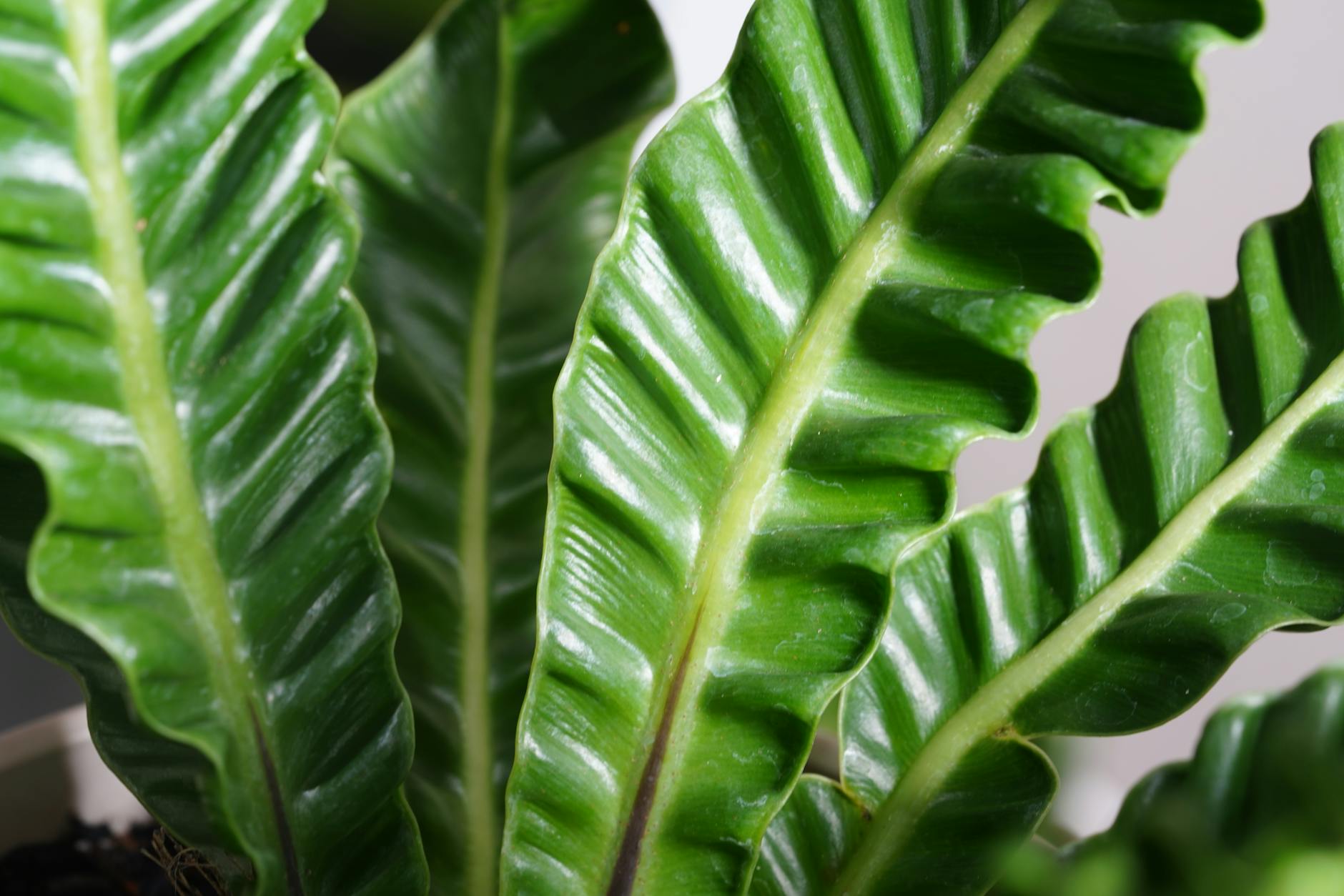
Unlike almost every fern you have encountered, the Bird’s Nest Fern has solid, undivided fronds. No feathery divisions, no delicate pinnae — just wide, glossy ribbons of green that feel almost artificial to the touch. Pick up a frond of Nephrolepis exaltata (the Boston Fern) and it falls apart; pick up a frond of Asplenium nidus and it holds its shape, firm and leathery. That structural difference reflects a different evolutionary origin and translates directly into different care: lower light, higher humidity comparable to what a Calathea Ornata needs, and a strict rule against watering into the crown.
At a glance: Bird’s Nest Fern care
- Light: Medium, indirect only. No direct sun — even brief exposure scorches the fronds.
- Water: Consistently moist, but never into the central crown.
- Humidity: High. This is the plant’s primary requirement.
- Temperature: 18-27°C ideal. Keep stable — no cold drafts.
- Toxicity: Non-toxic. Safe for cats, dogs and horses.
- Difficulty: Medium. Consistent humidity and correct watering technique are the critical points.
What is a Bird’s Nest Fern?
Asplenium nidus is native to tropical regions across Asia, Australia, and East Africa, where it grows as an epiphyte — attached to the trunks and branches of large trees, not rooted in the ground. In the wild it collects debris and organic matter in its central rosette, creating its own growing medium high above the forest floor. The central “nest” that gives the plant its name was designed to catch exactly this: falling leaves, bark, and moisture from rain and fog.
That epiphytic origin explains the plant’s sensitivity to its growing conditions. It has adapted to consistent moisture at the roots, high ambient humidity, dappled shade under a canopy, and stable warm temperatures. Reproducing those conditions indoors — rather than treating it like a standard potted plant — is what separates Bird’s Nest Ferns that thrive from those that slowly deteriorate.
The Bird’s Nest Fern belongs to the genus Asplenium, which includes hundreds of fern species found from tropical rainforests to temperate woodlands. Many of them are the typical feathery, divided-frond ferns most people picture. Asplenium nidus is unusual within its genus for its entire, undivided fronds — a trait shared with a few related species but not the broader fern world.
New fronds emerge from the central crown in a tightly coiled spiral that unfurls slowly over days. This emergence is one of the more visually satisfying things to watch in the houseplant world: the new growth appears dark green and almost black, gradually lightening to the plant’s characteristic bright green as it matures.
How much light does a Bird’s Nest Fern need?
Asplenium nidus needs medium, indirect light — and specifically, no direct sun. Even brief direct sunlight scorches the smooth fronds, leaving yellow or brown patches that are immediately obvious on the otherwise uniform surface.
A spot 1-2 metres back from an east- or north-facing window is ideal. The plant grows well in consistently moderate ambient light. A bright north-facing room suits it; a south-facing windowsill does not.
Signs your Bird’s Nest Fern needs more light:
- Very slow growth with fewer new fronds emerging than expected in spring and summer
- Fronds becoming very pale and losing their deep green colour over time
- The plant looking static for months without visible change
Signs of too much light:
- Yellow or brown patches on frond surfaces, particularly on the exposed faces
- Fronds bleaching from deep green toward yellowed green
- New fronds arriving noticeably lighter in colour than established ones
How often to water a Bird’s Nest Fern
The Bird’s Nest Fern needs consistently moist soil — never dry, never waterlogged. Water when the top 1-2cm of soil feels dry, but never allow the soil to dry out completely.
Critical technique: never water into the crown. The central rosette where new fronds emerge is the plant’s most vulnerable point. Water that pools there does not drain and creates conditions for crown rot — a fungal deterioration that can destroy the growing point and prevent new fronds from emerging. Always water the soil directly, using a narrow-spouted watering can if necessary to direct the water to the pot edges rather than the centre of the plant.
Water quality matters. Asplenium nidus is sensitive to fluoride and chlorine in tap water, both of which contribute to brown frond edges. Use filtered water, distilled water, or let tap water stand overnight in an open container before using.
Signs of overwatering:
- Fronds yellowing from the base
- A sour smell from the potting mix
- Soil staying wet for more than a week
- Crown looking dark or soft at the centre
Signs of underwatering:
- Frond edges becoming brown and papery
- Fronds losing their upright posture and flopping outward
- Soil dry more than 1cm below the surface
The right humidity for a Bird’s Nest Fern
High humidity — 60% or above — is the Bird’s Nest Fern’s most important care requirement. In average home humidity (40-50%), the frond edges gradually brown regardless of correct watering. In the dry air of centrally heated rooms in winter, the deterioration is faster.
Practical approaches:
- A bathroom with a window that receives adequate light is the ideal location for this plant — high ambient humidity from daily use, stable warmth
- A humidifier running nearby in winter is the most reliable solution
- Grouping with other plants raises ambient humidity modestly
- A pebble tray with water beneath the pot helps at the immediate root level
The fronds themselves can be misted lightly — unlike a Maidenhair Fern, where misting is largely ineffective, the wide frond surface of the Bird’s Nest Fern retains moisture slightly longer and benefits briefly from the added humidity.
Best temperature range for a Bird’s Nest Fern
Asplenium nidus grows best between 18-27°C and tolerates brief drops to 10°C. Growth slows considerably below 16°C.
What to avoid:
- Cold drafts from windows, doors, or air conditioning vents directly on the plant
- Temperatures below 12°C for more than a brief period
- Placing the pot against a cold exterior wall in winter
Temperature stability is important. The combination of warmth and high humidity that the plant requires tends to go together — a warm bathroom is both warm and humid; a cold spare room is both cold and dry.
The best soil and pot for a Bird’s Nest Fern
A peat-free, moisture-retaining potting mix works best — the goal is a medium that holds some moisture without becoming waterlogged. A mix designed for ferns, or a standard mix improved with 15-20% coir (coconut fibre), suits the epiphytic root system well. Avoid very chunky aroid mixes that drain too fast.
The pot should have drainage holes — consistent moisture does not mean standing water. In its natural habitat the plant’s roots are never submerged; moisture drains away between rains.
Repot every 2 years or when roots are visibly circling the bottom of the pot.
When and how to fertilize a Bird’s Nest Fern
Fertilize every 2 months during spring and summer with a balanced liquid fertilizer at half the recommended strength. The Bird’s Nest Fern is a slow, moderate feeder. Over-fertilizing causes salt accumulation at the frond edges — the same symptom as low humidity or fluoride water, which makes diagnosis confusing. When in doubt, fertilize less rather than more.
Stop in autumn and skip winter. Skip the first 4-6 weeks after repotting.
How to propagate a Bird’s Nest Fern
Asplenium nidus reproduces via spores — tiny dust-like particles produced in rows (called sori) on the undersides of mature fronds. Spore propagation is technically possible but requires sterile conditions, specific humidity, several months of waiting, and specialist knowledge. It is not a practical home propagation method.
For most growers, the answer is: buy a new plant. Bird’s Nest Ferns do not produce offsets, runners, or divisions. The plant grows as a single rosette that does not naturally split. Occasionally a very old plant will produce a second growing point, which can theoretically be divided, but this is rare.
Is Bird’s Nest Fern toxic to pets?
No — Asplenium nidus is non-toxic to cats, dogs and horses. The Bird’s Nest Fern contains no known toxic compounds and is safe in households with animals. The wide, sturdy fronds may attract curiosity but cause no harm if chewed or touched.
This pet-safe status, combined with the plant’s tolerance of lower light and its dramatic visual appearance, makes it a useful choice for homes where most striking houseplants would be off-limits due to pet safety concerns.
Cultivars at a glance
Asplenium nidus 'Crispy Wave'
Strongly rippled, wavy frond edges. Very popular in Japan and increasingly common worldwide.
Asplenium nidus 'Osaka'
Narrow, strongly ruffled fronds. More compact than the standard species.
Quick problem look-up
Brown frond edges
Brown frond edges result from low humidity or fluoride in tap water. Existing brown edges will not recover, but new fronds growing after conditions improve will be undamaged. Increase humidity to 60-80% using a pebble tray or humidifier. Switch to distilled or filtered water, avoiding chlorinated tap water. Mist fronds weekly and maintain consistent moisture without waterlogging the soil.
Yellow fronds
Yellow fronds indicate overwatering or excessive direct sunlight — patchy yellowing points to sun exposure, while uniform yellowing across the whole frond usually means overwatering. Allow soil to dry slightly between waterings and ensure drainage holes prevent water sitting. Move your fern away from direct sun to bright, indirect light. Check that fertilizer strength isn't excessive during growing season.
No new fronds emerging
Lack of new fronds stems from insufficient light, cold temperatures below 18 Celsius, or crown damage. New growth emerges slowly even in good conditions — 4 to 6 weeks between fronds is normal, so don't mistake that pace for a problem. Provide bright, indirect light for 8-10 hours daily. Maintain warmth between 21-24 Celsius and avoid temperature fluctuations. Ensure proper watering technique to prevent crown rot.
Rotting crown
Crown rot develops when water pools in the central rosette, usually producing soft, dark tissue with an unpleasant smell. Always water soil directly at the base, never into the crown centre. Allow excess water to drain completely. If rot appears, trim affected leaves and improve air circulation. Repot if damage is severe.
Do you ever wonder when your plant needs water or feeding?
GreenIQ tracks it per plant and reminds you at the right moment — adjusted to the season, not a fixed day.
Free, no account, no tracking.
Download GreenIQMore plants like this
Similar plants with comparable care needs or aesthetic.
You might also like
Asplenium nidus · Last updated May 2026 · Photo by hartono subagio on Pexels