Plant Care Guide
Staghorn Fern Care: The Complete Guide
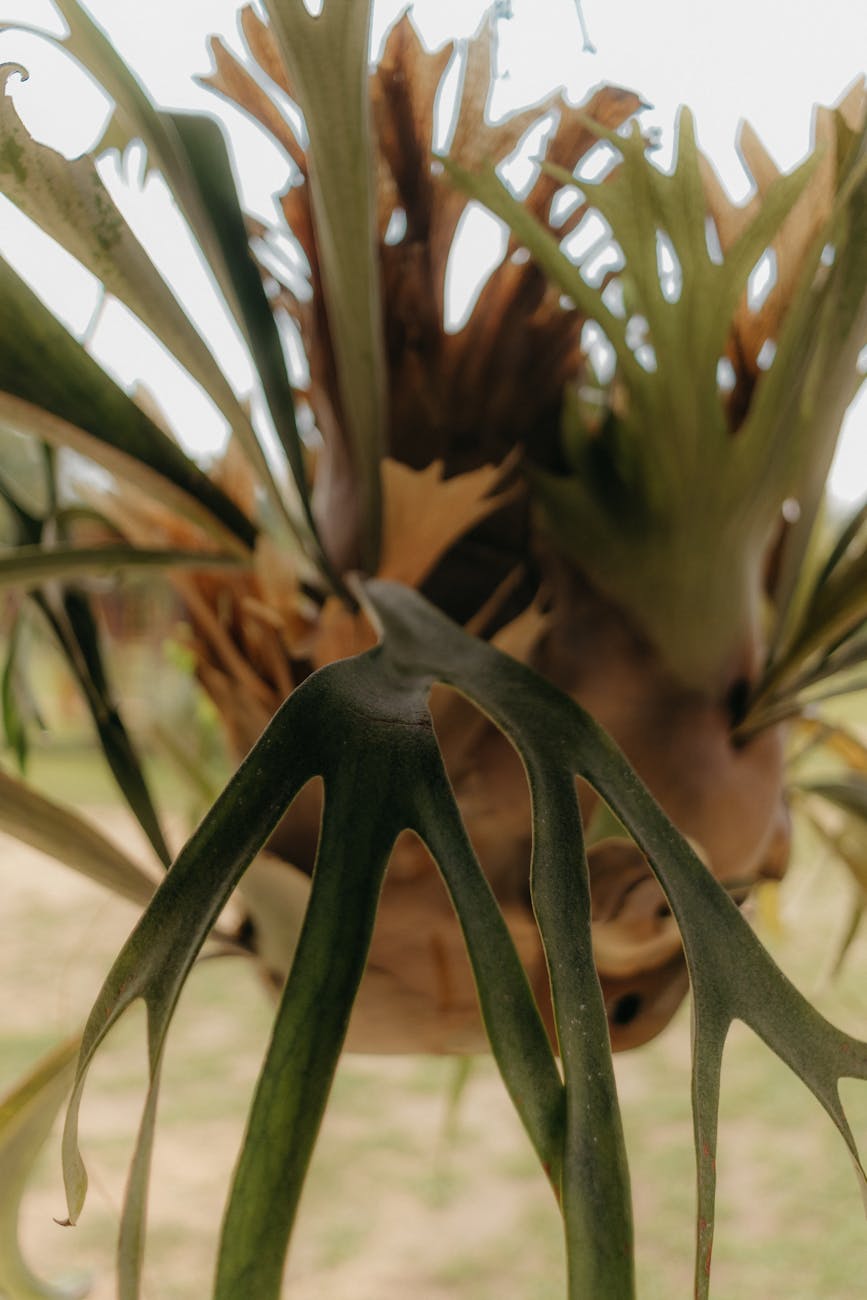
Staghorn Fern (Platycerium bifurcatum) is an epiphytic fern native to eastern Australia and New Guinea, known for its antler-shaped green fronds extending outward, flat brown shield fronds anchoring it to a mount, and natural tree-dwelling habit that requires wall mounting rather than potting indoors. Water by soaking the mount every 7–10 days in summer and every 14–21 days in winter.
Quick facts
From across a room, a mounted Staghorn Fern looks like something removed from the wall of a natural history museum. The antler-shaped green fronds extending outward in multiple directions, the flat brown fronds gripping the mount like pressed leather, the entire plant growing perpendicular to the wall rather than upright from a pot — none of this is how people expect a fern to look. It is not accidental: Platycerium bifurcatum evolved to live attached to the branches and trunks of trees in the forests of eastern Australia, and every aspect of its form reflects that epiphytic origin, much like a Moth Orchid. The wall mount is not a horticultural affectation; it is the most accurate approximation of how this plant is supposed to grow.
At a glance: Staghorn Fern care
- Light: Bright, indirect. Tolerates some gentle morning sun; no direct midday sun.
- Water: Soak the entire mount for 10–15 minutes every 1–2 weeks; allow to partially dry before repeating.
- Humidity: High. 50–70% ideal; tolerates somewhat lower with adequate watering.
- Temperature: 16–27°C. Do not allow to drop below 10°C.
- Toxicity: Non-toxic to cats, dogs, and horses.
- Difficulty: Medium. The mounting setup and soaking method are unfamiliar to most growers.
What is a Staghorn Fern?
Platycerium bifurcatum is native to the coastal forests of Queensland and New South Wales in eastern Australia, as well as parts of Indonesia and the southern Pacific islands. In its natural habitat it grows as an epiphyte attached to tree bark — using the structure of the tree for physical support while absorbing nutrients from decomposing organic matter, rainwater, and humidity rather than from soil below.
The genus Platycerium contains around 18 recognised species. Bifurcatum is the most widely cultivated, the most cold-tolerant of the genus, and the most reliably available in the houseplant trade. Its common name comes from the antler-like forking of the green foliage fronds, which in large specimens can extend 80–90 centimetres or more in multiple directions.
The plant produces two distinct frond types with entirely different functions. Shield fronds (also called basal or nest fronds) are flat, rounded, and initially green before turning brown and papery with age. They serve two purposes: anchoring the plant to its mount, and trapping falling organic material — leaf litter, insect debris, rainfall — that provides nutrients. Shield fronds are not dead or diseased when they turn brown; they are fulfilling their structural and nutritional function. Do not remove them. Foliage fronds are the antler-shaped green fronds that extend outward from the shield. These carry the spores and perform photosynthesis.
How much light does a Staghorn Fern need?
Platycerium bifurcatum needs bright, indirect light — close to a window but protected from direct midday and afternoon sun. An east-facing wall position, where the plant receives gentle morning sun and bright ambient light through the rest of the day, is close to ideal. A few metres from a south- or west-facing window, out of the direct beam but in full ambient light, also works.
The plant tolerates some gentle direct morning sun — particularly in autumn and winter when light intensity is lower — but prolonged direct sun bleaches and damages the foliage fronds.
Signs your Staghorn Fern needs more light:
- Foliage fronds becoming pale and producing fewer antler divisions at the tips
- Very slow growth over multiple months
- Fronds lying flat rather than extending actively outward
Signs of too much direct sun:
- Brown patches on the upper surface of foliage fronds
- Fronds becoming papery and losing their firm, arching structure
- General yellowing of green fronds while shield fronds remain unchanged
How often to water a Staghorn Fern
Watering a mounted Staghorn Fern requires a completely different approach from watering a potted plant. The correct method is soaking: submerge the entire mount in a basin or bucket of room-temperature water for 10–15 minutes, allow it to soak thoroughly, then remove and let it drain completely before returning it to the wall.
In summer at normal room temperatures (20–25°C), soaking every 7–10 days is typical. In winter, every 12–14 days is usually sufficient. The mount should be allowed to dry partially — not completely — between soakings. The sphagnum moss at the base should feel lightly damp, not saturated and not bone dry.
Between full soaks, lightly misting the foliage fronds every 2–3 days in warm weather helps maintain humidity around the plant without waterlogging the mount.
Signs of overwatering:
- Blackening or softening at the base of the foliage fronds, where they meet the shield fronds
- A persistent musty smell from the mount
- The sphagnum moss remaining saturated for more than 5 days after soaking
Signs of underwatering:
- Foliage fronds losing their firm structure and beginning to droop or shrivel
- Shield fronds becoming dry and crumbling at the edges
- The sphagnum moss feeling completely bone dry
The right humidity for a Staghorn Fern
Platycerium bifurcatum is more tolerant of variable humidity than most epiphytic plants — 50–70% is the target range, and the plant handles drops to 40% without serious damage in well-watered specimens. What it cannot tolerate is the combination of low humidity and hot dry air from a heating vent positioned directly at the mount.
Practical approaches:
- A bathroom or kitchen with bright ambient light is a good location — both rooms maintain higher baseline humidity than living areas, the same reasoning behind a Boston Fern or Bird’s Nest Fern in the same spot
- Regular misting of the foliage fronds between soakings contributes meaningfully to the local humidity around the mount
- Grouping with other plants raises ambient humidity modestly through combined transpiration
- A humidifier running nearby is the most reliable active solution in winter
Best temperature range for a Staghorn Fern
The Staghorn Fern grows best in 16–27°C and is one of the more cold-tolerant Platycerium species — it handles brief drops to 5–8°C without permanent damage, which is more resilience than most houseplant ferns offer. This cold tolerance makes it suitable for moving outdoors to a sheltered, bright position in summer in temperate climates.
What to avoid:
- Sustained temperatures below 10°C (cold damage to foliage fronds occurs over time)
- Frost — P. bifurcatum is frost-sensitive despite its relative cold tolerance
- Hot, dry drafts from air conditioning or heating vents directed at the mount
The best mounting setup for a Staghorn Fern
Staghorn Ferns are not grown in pots. The correct setup is a wooden board mount — cedar, oak, or untreated pine are all suitable — with a backing of damp sphagnum moss placed between the plant and the board. The plant is secured with fishing line or soft wire passed through the shield fronds and around the board. This allows water to drain freely after soaking, air to circulate around the roots and moss, and the plant to grow in its intended orientation.
The sphagnum moss should be replaced every 2–3 years or when it begins to decompose. A board that has become too small for the expanding shield fronds should be replaced — cut the fishing line carefully and remount onto a larger board with fresh sphagnum.
If a Staghorn Fern must be temporarily potted (for example, while establishing a young pup), use a free-draining mix of bark, coir, and perlite. Move to a mount as soon as the plant is large enough to establish itself.
When and how to fertilize a Staghorn Fern
Fertilize monthly during the growing season (spring and summer) with a diluted liquid fertilizer at half the recommended strength. An effective organic alternative: tuck a banana skin or small piece of decomposing organic matter behind the shield fronds at the base of the mount. As it breaks down, it releases potassium and phosphorus directly into the shield fronds — replicating the composting material the plant collects naturally in the wild.
Stop fertilizing in autumn and skip winter entirely.
How to propagate a Staghorn Fern
Propagation from pups (offsets) is the standard method. Mature Staghorn Ferns produce small plantlets at the base of the shield fronds, which can be separated and mounted independently once large enough.
- Wait until the pup has developed at least 2–3 foliage fronds and visible shield frond development. Separating too early reduces survival rate significantly.
- Using a clean, sharp knife, cut the connecting tissue between the pup and parent at the base of the shield fronds.
- Prepare a small mounting board with fresh sphagnum moss.
- Press the pup’s shield fronds against the moss and secure with fishing line or soft wire — do not puncture the foliage fronds.
- Keep the new mount in a humid location with good indirect light and soak every 5–7 days initially while roots establish.
Pups removed before significant shield frond development rarely establish successfully. Patience in timing the separation is the most important variable.
Is Staghorn Fern toxic to pets?
No — Platycerium bifurcatum is non-toxic to cats, dogs, and horses. The plant contains no known toxic compounds and is safe in households with animals. A cat jumping at the antler-shaped foliage fronds — which happens — will not be harmed.
Cultivars at a glance
Platycerium bifurcatum 'Netherlands'
Compact form with shorter, more densely branched antler fronds. Well suited to smaller mounting boards.
Platycerium bifurcatum 'Lemoine'
Larger fronds than the standard species. More impressive as a wall-mounted specimen.
Quick problem look-up
Brown or blackening fronds
Brown or blackening fronds indicate overwatering at the base — but browning confined to just the lower tips of otherwise healthy fronds is often normal tip aging, not a problem. Staghorn ferns need moisture but despise constant wetness. Soak the mount thoroughly every 10-14 days during growing season, then let it dry significantly before the next watering. Ensure excellent air circulation around the mount to prevent rot at the rhizome.
No new growth
Insufficient light prevents new growth development. Staghorn ferns need bright, filtered indirect light for 12+ hours daily to thrive. Position your mount near an east or west-facing window with sheer curtain diffusion, or 60-90 cm from a south-facing window. If light is the only limiting factor, growth resumes within 4-6 weeks of moving to a brighter spot. Inadequate light otherwise stops the frond-producing cycle.
Yellow fronds
Yellow fronds typically result from overwatering or soggy mounting medium. Allow the wooden mount to dry out more between soakings, especially during cooler months. Water every 10-14 days in growing season; reduce frequency in autumn and winter. Yellow leaves may also indicate nutrient deficiency, so apply diluted fertilizer monthly during spring and summer growth.
Scale insects
Scale insects frequently attack mounted staghorn ferns, hiding where fronds meet shield fronds and under leaf surfaces. Inspect these areas weekly using a magnifying glass. Remove scales manually with a soft brush dipped in neem oil solution. Treat the entire plant every 7-10 days for three weeks. Improve air circulation to deter pest colonization and regular misting encourages natural pest resistance.
Do you ever wonder when your plant needs water or feeding?
GreenIQ tracks it per plant and reminds you at the right moment — adjusted to the season, not a fixed day.
Free, no account, no tracking.
Download GreenIQMore plants like this
Similar plants with comparable care needs or aesthetic.
You might also like
Platycerium bifurcatum · Last updated June 2026 · Photo by Kawê Rodrigues on Pexels